
Can You Recover Lost Wages After a Car Accident Injury in South Carolina?
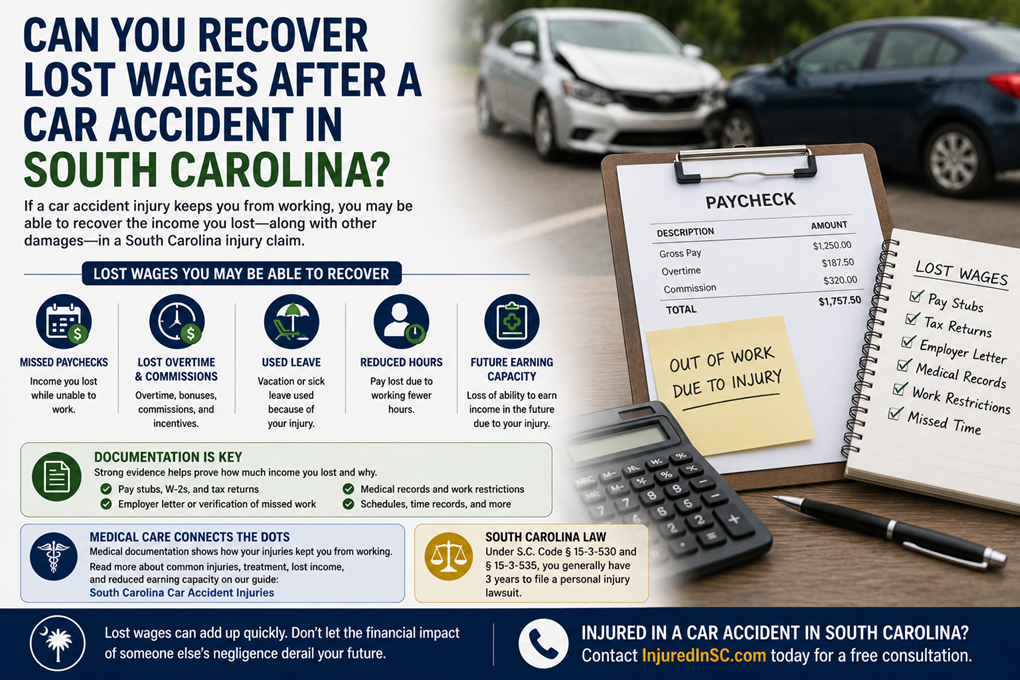
A car accident injury can affect more than your health.
If pain, medical appointments, surgery, physical therapy, or work restrictions keep you from doing your job, the financial consequences may begin almost immediately.
A lost wages car accident claim in SC may allow an injured person to seek compensation for income lost because of injuries caused by another driver’s negligence.
Depending on the circumstances, that can include more than simply counting the days you missed work.
The key is being able to document both the amount of income you lost and the connection between the accident, your injuries, and your inability to work.
What Are Lost Wages After a Car Accident?
Lost wages generally refer to income you would have earned if the accident-related injury had not prevented you from working.
Examples may include:
- Regular hourly wages
- Salary attributable to missed work
- Lost overtime
- Missed commissions
- Lost bonuses that can be supported with evidence
- Sick leave or vacation time used because of the injury
- Reduced hours caused by medical restrictions
- Income lost while attending accident-related medical appointments
This South Carolina Car Accident Injuries guide identifies lost income as a potential category of damages and notes that pay records, tax documents, employer statements, schedules, and written medical restrictions may help establish the loss.
Not every missed paycheck automatically becomes recoverable. The evidence generally needs to show that the absence or reduction in work resulted from the collision-related injury.
What Evidence Can Prove Lost Wages?
A strong lost wages car accident claim in SC usually requires more than simply telling an insurance adjuster how much money you missed.
Useful documents may include:
- Recent pay stubs
- W-2 forms
- Tax returns
- Work schedules
- Attendance records
- Payroll statements
- Employer letters
- Medical work restrictions
- Disability notes
- Records of missed overtime
- Commission histories
- Bonus records
An employer letter can be particularly helpful when it identifies your normal rate of pay, typical hours, the dates you missed work, and the amount of income lost.
Medical documentation is also important. If your doctor restricted lifting, driving, standing, computer work, or another activity necessary for your job, keep a copy of those instructions.
The article on chronic pain after a South Carolina car accident also discusses documenting missed work, reduced hours, work restrictions, and changes in job duties when an injury continues to affect employment.
What If You Used Vacation or Sick Leave?
Using paid leave can complicate the calculation.
You may have continued receiving a paycheck while using accumulated vacation or sick time, but that does not necessarily mean the accident caused no employment-related loss.
The injury may have forced you to use benefits that otherwise would have remained available to you.
Keep records showing how much leave you had before the collision, how much you used because of the injury, and why the leave was necessary.
Whether a particular loss is recoverable depends on the facts and applicable law, so the documentation matters.
Can Self-Employed Workers Claim Lost Income?
Yes, but proving the amount can be more complicated.
An employee may be able to establish losses using payroll records and an employer statement.
A self-employed person may need to show what the business or individual normally earned and what income was actually lost while the injury interfered with work.
Relevant evidence may include:
- Tax returns
- 1099 forms
- Profit-and-loss statements
- Bank records
- Invoices
- Customer contracts
- Appointment calendars
- Canceled jobs
- Business records from comparable periods
For example, a contractor who cannot perform physical work for six weeks may need records showing normal earnings during that period rather than simply estimating what might have been earned.
Avoid inflating expected income. Insurers may scrutinize a self-employment claim closely, particularly when income fluctuates from month to month.
What Is Reduced Earning Capacity?
Lost wages generally address income already missed.
Reduced earning capacity concerns the effect an injury may have on your ability to earn money in the future.
A serious injury might prevent someone from returning to the same occupation, working the same number of hours, performing physically demanding tasks, or advancing along the same career path.
The South Carolina Car Accident Injuries guide distinguishes lost income from reduced earning capacity and explains that future earning claims often require detailed medical, employment, and financial evidence.
These claims can become especially important after spinal injuries, brain injuries, permanent mobility limitations, or chronic pain that prevents a person from returning to prior job duties.
Medical Evidence Connects the Injury to Missed Work
An insurer may question a wage claim if there is little medical support showing why you could not work.
For example, an adjuster may ask:
- Did a healthcare provider take you out of work?
- Were you given lifting or activity restrictions?
- How long were the restrictions supposed to last?
- Did you return to work when medically cleared?
- Were missed days related to the accident or another condition?
This is one reason treatment gaps can complicate an injury claim.
If you stop receiving medical care but remain out of work, the insurer may question whether the continued absence was medically necessary.
The firm’s discussion of a gap in treatment for a car accident claim explains why consistent treatment records can matter.
You should not ask a healthcare provider for unnecessary restrictions simply to increase a claim. Medical decisions should reflect your actual condition and the duties your job requires.
How Injuries Affect Both Work and the Larger Claim
Lost wages rarely exist in isolation. The same injury that prevents you from working may also generate medical expenses, physical limitations, pain, and changes in your daily life.
For a broader explanation of these issues, the firm’s South Carolina Car Accident Injuries guide covers common injuries, medical documentation, delayed symptoms, treatment, lost income, and reduced earning capacity.
That broader medical picture can help explain why you missed work. A person recovering from a concussion, for example, may have difficulty concentrating or tolerating computer screens, while someone with a herniated disc may be unable to lift, bend, drive, or remain seated for long periods.
Can Fault Reduce Your Lost-Wage Recovery?
Yes. South Carolina law provides that contributory negligence does not bar recovery in a motor-vehicle accident when the injured person’s negligence is equal to or less than the negligence required of the opposing party.
In practice, an injured person’s share of responsibility can reduce the damages recovered under South Carolina’s modified comparative-negligence framework.
This means proving lost wages is only part of the claim. Evidence showing how the collision happened—such as photographs, video, witness statements, and the collision report—can also affect the final recovery.
The firm’s article on what determines the value of a South Carolina personal injury settlement explains that lost income is one of several factors considered along with liability, medical evidence, insurance coverage, and long-term limitations.
Do Not Settle Before You Understand Your Work Limitations
An early settlement may arrive while you are still missing work or before you know whether you can return to your previous duties.
Before signing a release, consider whether you have documentation of all wages already lost and whether your injury could affect future employment.
Once a claim is settled and released, you generally cannot return later simply because you missed additional work or discovered that permanent restrictions reduced your earning ability.
The firm’s guide to the car accident settlement timeline in South Carolina discusses why ongoing treatment and an uncertain medical prognosis may affect when a claim is ready for evaluation.
How Long Do You Have to File a South Carolina Claim?
South Carolina Code Sections 15-3-530 and 15-3-535 generally provide a three-year limitations period for personal injury actions subject to the statutory discovery rule.
Different deadlines or procedures may apply in particular circumstances, including some claims involving government defendants.
Do not assume that insurance negotiations or continuing wage losses extend the filing deadline.
Document the Full Financial Effect of Your Injury
A lost wages car accident claim in SC can involve regular pay, overtime, commissions, used leave, reduced hours, and—in more serious cases—future earning limitations.
The more clearly employment, medical, and financial records document those losses, the easier it is to explain their connection to the accident.
If injuries from a South Carolina collision have caused you to miss work or limited your ability to earn income, contact a South Carolina Personal Injury Lawyer to discuss your documentation, insurance claim, and the legal options that may apply.
This article provides general legal information and is not legal advice. Every claim depends on its individual facts, evidence, insurance coverage, and applicable law. No particular recovery or result is guaranteed.
Ready To Take Action?
It won’t cost you anything to speak with an attorney about your case.