
How Pre-Existing Conditions Affect a South Carolina Car Accident Claim
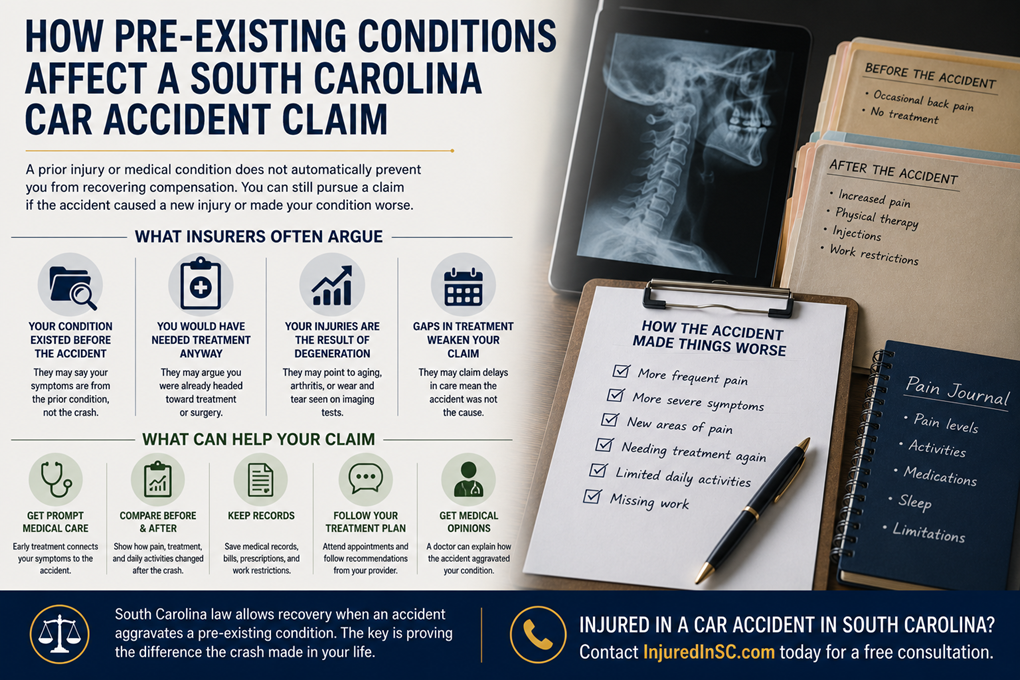
Many people have arthritis, degenerative disc changes, an old sports injury, recurring headaches, or occasional neck and back pain before they are involved in a collision.
The fact that a person has a preexisting medical condition does not mean that they are unable to claim compensation when another driver causes them a new injury or makes an existing one worse.
On the other hand, having a pre-existing condition can complicate an insurance claim.
The insurance company might say that the accident did not cause your symptoms, that you would have required treatment all the same, or that your present limitations are just as much as those you had before the accident.
If you want to be ready for the arguments concerning how pre-existing conditions affect a car accident claim in SC, it’s important to keep evidence that shows what changed following the collision.
Medical documentation, treatment history, diagnostic findings, fault, insurance coverage, and the injury’s effect on daily life may also be important.
Our complete guide to South Carolina car accident injuries and claims provides a broader explanation.
What Is Considered a Pre-Existing Condition?
A pre-existing condition is usually a health issue, injury, or physical limitation that was present before the accident; it might have been causing symptoms, had been controlled by treatment, or could have been entirely unknown until some imaging was done after the crash.
Examples may include:
- Degenerative disc disease
- Arthritis
- Prior herniated or bulging discs
- An earlier neck, back, shoulder, or knee injury
- Previous surgery
- Recurring migraines
- Fibromyalgia or another chronic-pain condition
- Anxiety, depression, or post-traumatic stress
- Osteoporosis
- A prior concussion
A report prepared by an imaging specialist might refer to the findings as degenerative, chronic, or age-related, but such descriptions do not definitely indicate whether the accident has caused new symptoms or has made an existing condition more severe.
For example, someone could have had spinal degeneration without experiencing any pain prior to the collision but after the accident they might then develop radiating pain, weakness, numbness, or become necessitated in receiving treatment.
The main point usually lies in the difference between the individual’s state before and after the crash.
Can You Recover for an Aggravated Condition?
South Carolina courts have recognized that a negligent party can be held responsible when an accident worsens an existing injury or illness.
The injured person has the right to claim damages for the worsening of their condition and for any new injuries that are directly caused by the accident.
However, the defendant is not always liable for medical problems which would have existed anyway, which means it can be important to distinguish the original condition from the change brought about by the accident.
A person who had occasional, manageable lower-back stiffness and did not need regular treatment or miss work could have an aggravation claim if a crash caused persistent nerve pain, months of therapy, work restrictions, or surgery, since that change would be evidence of aggravation.
It doesn’t mean that all the symptoms that appeared after the accident were caused by the car accident.
To prove the connection, the medical records, the providers’ opinions, the diagnostic findings, and the timing of the symptoms must be taken into account.
Why Insurance Companies Focus on Medical History
When assessing the impact of pre-existing conditions on a car accident claim in South Carolina, insurance companies usually compare past medical records with those currently available.
They may look for:
- Similar symptoms reported before the crash
- Earlier diagnostic imaging
- Previous accidents or workplace injuries
- Gaps in treatment after the collision
- Statements suggesting symptoms were unchanged
- Medical opinions about degeneration or natural disease progression
- Differences between what you told individual providers
The insurer could say that the treatment you are receiving is related to the previous condition rather than the accident and might also claim that the crash has only caused a temporary worsening of your symptoms, which have now gone away.
That is why it is important to be consistent.
You should let your healthcare providers know about your medical history, but you must also describe exactly how your symptoms have changed.
If an old injury is hidden, your credibility may be damaged when earlier records are found.
Compare Your Life Before and After the Crash
One of the most useful methods of recording an aggravation is to make a clear comparison between the situation before and after.
Before the collision, consider:
- How often you experienced pain
- Whether you were receiving treatment
- Which medications you used
- Whether you had work restrictions
- Whether you exercised or participated in hobbies
- Which household and family activities you performed
- Whether the condition affected your sleep or mobility
After the auto accident, make a record of any changes. For example, pain which used to occur once a month might now be constant, or you may have had to take stronger medication, restarted treatment after a number of years without symptoms, missed work, or given up the activities you had previously enjoyed.
This article on documenting chronic pain after a South Carolina car accident explains how medical records, journals, employment documents, and examples from daily life can show an injury’s practical impact.
Medical Records May Be Crucial
Prior medical records are not always harmful to a claim. In some cases, they may show that the earlier condition was stable, required limited care, or had not caused symptoms for years.
Post-accident records may document:
- New areas of pain
- Increased symptom frequency or severity
- Reduced range of motion
- Weakness, numbness, or tingling
- New diagnostic findings
- Additional medications
- Referrals to specialists
- Physical therapy, injections, or surgery
- Work and activity restrictions
A doctor who is treating a patient might be able to say whether the collision caused a new injury, worsened an existing condition, or sped up the need for treatment.
Cases in South Carolina concerning worsened conditions show how important it is for medical evidence to link the accident with the increased symptoms and the need for treatment.
It doesn’t follow that if you have a normal X-ray you have not suffered an injury; some injuries to muscles, ligaments, tendons, discs, and nerves may need a physical examination or other forms of imaging in order to be assessed.
The article on soft-tissue injuries after a South Carolina car wreck discusses why these conditions can be difficult to prove.
What If You Did Not Know About the Condition?
An accident can be the reason for having an MRI or some other test that shows that a person has arthritis, disc degeneration, or some previous condition that they were not aware of.
An insurer could say that the test only revealed a long-existing problem. Regardless, the fact that there was an earlier condition does not necessarily account for why the symptoms started after the collision.
Evidence that you were active, working without restrictions, and not receiving treatment before the wreck may help establish that the condition was previously asymptomatic or manageable. Medical evidence must still connect the collision to the new symptoms or aggravation.
Spinal injury claims often involve this issue. For more information on herniated discs following car accidents in South Carolina and the way prior degeneration might affect the assessment of a claim.
Steps That May Help Protect Your Claim
It is important to seek medical help as soon as the symptoms appear. Although delayed symptoms are possible, a lengthy period without any explanation could enable the insurer to claim that some other event led to the condition.
For further information on symptoms that appear after the accident scene, see the firm’s article on personal injury in South Carolina.
Give providers an accurate history, attend appointments, and follow reasonable treatment recommendations. Keep earlier and current records, bills, prescription information, wage documents, and a factual symptom journal.
Do not sign general medical authorizations unless you fully understand their scope, since an insurance company might request records that go far beyond the body parts or time period relevant to the claim.
Also, avoid discussing your condition casually on social media, as your posts may be seen without context.
How Are Damages Evaluated?
A claim based on an aggravated condition can cover accident-related medical bills, lost income, pain, decreased function, and reasonably supported future care.
The amount depends on how much the collision worsened the condition, not just that a prior diagnosis existed.
Relevant questions may include:
- Did the accident cause new symptoms?
- Did existing symptoms become more severe or frequent?
- Did the person require different treatment?
- Were new work restrictions imposed?
- Did the collision accelerate surgery or other care?
- Are the new limitations temporary or lasting?
- What insurance coverage is available?
Every claim depends on its medical and factual evidence. No universal calculator can reliably separate the value of a prior condition from the harm caused by a new accident.
South Carolina’s General Filing Deadline
A personal injury claim must generally be started within three years of the time when the person knew, or could have reasonably known through due diligence, that a cause of action had arisen, in accordance with South Carolina Code Sections 15-3-530 and 15-3-535.
However, different rules apply in cases involving a government agency, a minor, wrongful death, or another special situation.
Do not wait until the deadline approaches. Earlier medical records, witnesses, video, and other evidence may become difficult to obtain over time.
Discuss How Your Condition Changed After the Accident
The answer to how pre-existing conditions affect a car accident claim in SC depends on what your health was like before the collision and what changed afterward.
A prior condition may create additional disputes, but it does not automatically defeat a claim.
If the car accident you had in South Carolina has made a previous injury worse or has turned a condition that was previously under control into one that is now painful, get in touch with a car wreck lawyer to talk over your medical history, your present symptoms, and the evidence that you have.
This article provides general legal and medical information. It is not legal advice or medical advice, and no outcome is guaranteed.
Ready To Take Action?
It won’t cost you anything to speak with an attorney about your case.