
Who Pays Your Medical Bills After a Car Accident in South Carolina?
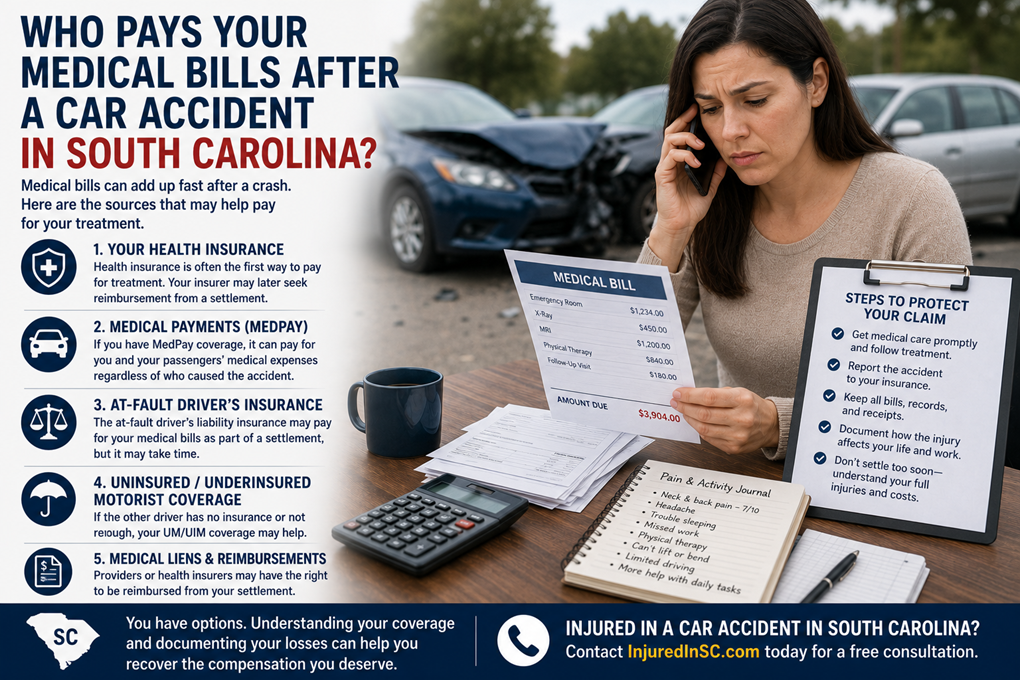
After a collision, medical bills can begin arriving before the insurance companies have even decided who caused the crash.
Emergency transportation, hospital treatment, diagnostic imaging, physical therapy, prescriptions, and follow-up visits can quickly create financial pressure.
This often leads injured people to ask: Who pays medical bills after a car accident in SC?
Although the driver who caused the accident may ultimately be responsible for accident-related losses, that driver’s insurance company usually does not pay each medical bill as it arrives.
During treatment, payment may come from your health insurance, optional Medical Payments coverage, or your own funds.
Medical expenses are only one part of the difficulties an injured person may face after a collision.
A claim may also involve lost income, future treatment, pain, physical limitations, and insurance coverage.
The responsible driver’s liability insurer may reimburse qualifying losses through a later settlement or judgment.
Understanding these different sources can help you manage bills without settling your claim before the extent of your injuries is known.
Review our South Carolina car accident injury guide for an overview of common injuries, medical care, compensation, and the claims process.
Are You Personally Responsible for the Bills?
When you receive medical treatment, the provider generally looks to you for payment.
A hospital or physician does not have to wait for the other driver’s insurance company to investigate the crash or negotiate a settlement.
This means your name may remain on the account even when someone else caused the accident.
Ignoring bills can lead to collection activity or damage to your credit, so open every statement and communicate with the provider.
Tell the billing office that your treatment resulted from a car accident.
Ask whether it has your correct health insurance information and whether a payment plan or temporary billing arrangement is available.
Keep copies of every bill, explanation of benefits, receipt, and collection notice.
Can You Use Your Health Insurance?
In many cases, health insurance is the first practical way to pay for accident-related treatment.
This may include private insurance, Medicare, Medicaid, or another health plan.
Using health insurance does not normally prevent you from making a personal injury claim.
It can help you obtain treatment while the liability claim is pending, and you may benefit from the rates negotiated between your insurer and medical providers.
You may still be responsible for deductibles, copayments, coinsurance, uncovered treatment, or care obtained outside the plan’s network.
Keep records of everything you pay personally because those expenses may be relevant to your claim.
Your health insurer may also seek reimbursement from a later recovery.
Under South Carolina Code Section 38-71-190, certain accident and health insurance policies may include a right of subrogation for benefits paid in connection with an injury caused by a liable third party.
The statute limits that right to benefits previously paid and provides a process for challenging subrogation that would be inequitable or unjust.
The rules can differ for employer-funded health plans, Medicare, Medicaid, and other benefit programs.
Do not distribute settlement funds until potential reimbursement claims have been identified and addressed.
What Is Medical Payments Coverage?
Medical Payments coverage, commonly called MedPay, is optional automobile insurance that may pay covered medical expenses for you or your passengers regardless of who caused the accident.
Whether it is available—and how much is available—depends on the policy.
MedPay can be especially helpful with:
- Ambulance and emergency-room bills
- Health insurance deductibles and copayments
- Diagnostic testing
- Physician visits
- Physical therapy
- Other covered accident-related treatment
South Carolina does not mandate personal injury protection coverage.
However, when an insurer sells qualifying no-fault medical payment, personal injury protection, or economic-loss coverage, South Carolina Code Section 38-77-144 states that the coverage is not assignable or subrogated and is not subject to a setoff.
Review the declarations page of every potentially applicable auto policy.
Coverage may sometimes be available through your policy, a household policy, or the policy covering the vehicle in which you were riding.
Will the At-Fault Driver’s Insurance Pay?
South Carolina requires drivers to maintain minimum bodily-injury liability limits of $25,000 for one injured person and $50,000 for all people injured in one accident.
Bodily-injury liability claims may include medical expenses, lost income, and other injury-related losses. (Department of Insurance South Carolina)
Even so, the at-fault insurer generally investigates before making a payment. The company may dispute:
- Which driver caused the wreck
- Whether its policyholder was legally responsible
- Whether particular treatment was related to the crash
- Whether the treatment was reasonable and necessary
- Whether a preexisting condition caused some symptoms
- The value of the claimed losses
Liability insurers commonly resolve medical expenses as one part of a complete bodily-injury settlement rather than paying providers visit by visit. That process may take time, particularly when treatment is ongoing or fault is disputed.
Before agreeing to a settlement, you should understand your diagnosis, prognosis, unpaid balances, possible future treatment, and reimbursement obligations. Signing a release generally ends the claim, even when additional bills appear later.
The firm’s discussion of South Carolina personal injury settlement factors explains how medical expenses, lost income, and the injury’s effect on daily life may influence a claim.
What Happens When the Other Driver Has No Insurance?
South Carolina automobile policies must include uninsured motorist coverage in at least the required minimum amounts.
This coverage may apply when an uninsured driver causes the accident or in certain hit-and-run cases. (South Carolina Courts)
Underinsured motorist coverage is different. It may help when the at-fault driver has insurance, but the available liability limit is not enough to cover the resulting losses.
Whether underinsured coverage exists depends on the policies involved and applicable South Carolina law.
A claim involving your own insurer is still an insurance claim. You must provide evidence of fault, injury, medical expenses, and other losses. Policy conditions and notice requirements may also apply.
Can a Medical Provider Place a Lien on Your Claim?
In some situations, a provider may agree to delay collection in exchange for payment from a future settlement.
The arrangement may be described as a medical lien, letter of protection, or agreement to withhold funds.
This does not make the treatment free. The balance usually remains payable, and the provider may seek payment from the recovery. Read every agreement carefully and keep a copy.
Bills and liens should be reviewed before a claim is settled. A settlement that looks sufficient at first may leave much less after medical balances, health-insurance reimbursement claims, case expenses, and other obligations are paid.
Steps That Can Help You Manage Medical Bills
First, obtain necessary medical care rather than waiting for the liability insurer to accept responsibility.
Delayed treatment can affect your health and may make it harder to connect your condition to the collision.
The article on delayed car accident injury symptoms in South Carolina explains why some problems become noticeable later.
Next, give providers accurate health and auto insurance information.
Confirm whether MedPay is available, and ask each provider for an itemized bill showing treatment dates, charges, insurance adjustments, payments, and the remaining balance.
Create one file for:
- Medical bills and records
- Health-insurance explanations of benefits
- MedPay correspondence
- Prescription and medical-equipment receipts
- Mileage and transportation expenses
- Work restrictions and lost-wage records
- Letters asserting liens or reimbursement rights
Also preserve photographs, witness details, the collision report, and communications from insurers.
Review what to do after a South Carolina car accident for additional evidence-preservation guidance.
How Long Can You Pursue Payment From the At-Fault Party?
South Carolina Code Sections 15-3-530 and 15-3-535 generally establish a three-year limitations period for a personal injury action, subject to the statutory discovery rule.
Different deadlines or notice requirements may apply when a government vehicle, public employee, minor, or other special circumstance is involved.
Do not wait until the deadline approaches. Insurance notice provisions may require earlier action, and important evidence can disappear long before the filing period expires.
Get Help Sorting Out Your Medical Bills and Claim
The answer to who pays medical bills after a car accident in SC often involves several sources.
Health insurance or MedPay may cover treatment initially, while a liability, uninsured motorist, or underinsured motorist claim may provide a later recovery.
Liens and reimbursement claims may then need to be resolved before the case is closed.
If medical bills are piling up after a South Carolina collision, contact a South Carolina car accident lawyer to discuss the available insurance coverage, outstanding balances, and legal options that may apply.
This article provides general legal information and is not legal advice. Insurance coverage and payment obligations depend on the policy language and the facts of the individual case. No result is guaranteed.
Ready To Take Action?
It won’t cost you anything to speak with an attorney about your case.