
Chronic Pain After a South Carolina Car Accident: How to Document Its Impact
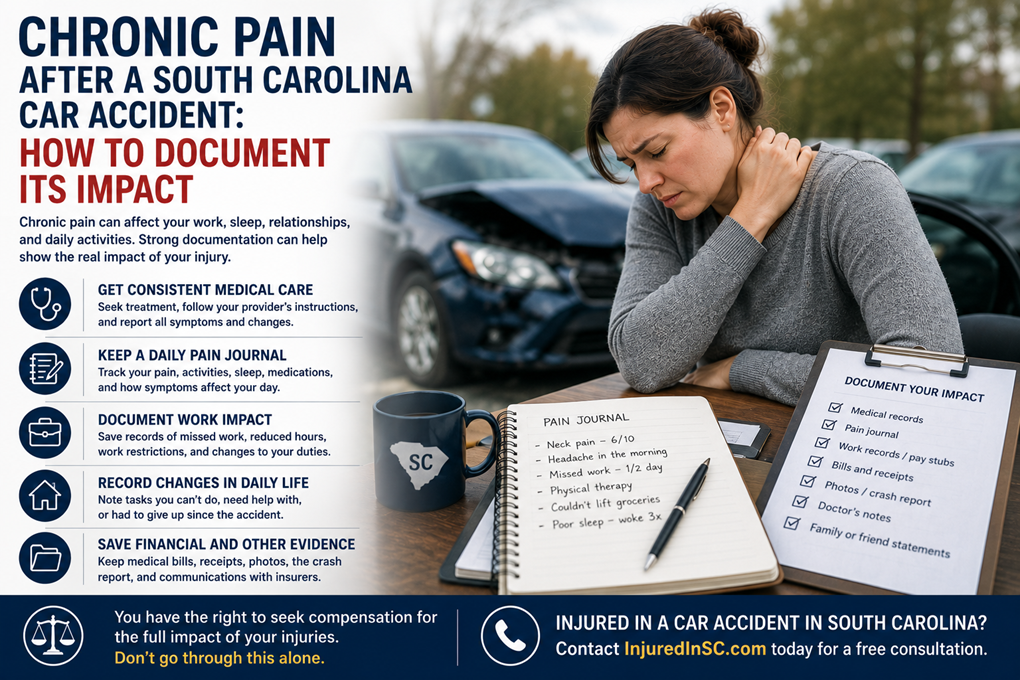
Pain after a collision does not always disappear once the bruises fade or the vehicle is repaired.
Neck, back, shoulder, nerve, and joint injuries can continue for months, affecting nearly every part of an injured person’s life.
When pursuing a claim involving chronic pain after a car accident in SC, describing the pain is only one part of the process.
Medical records and other evidence should also show how the condition affects your movement, sleep, employment, relationships, and ability to complete ordinary activities.
Careful documentation can give healthcare providers a clearer picture of your condition and help an insurer, attorney, judge, or jury understand an injury that may not be visible.
What Is Chronic Pain?
Chronic pain can develop from several types of car accident injuries, including spinal conditions, nerve damage, joint injuries, and soft-tissue trauma.
For a wider discussion of these conditions and the evidence that may support a claim, read our guide to car accident injuries in South Carolina.
The Centers for Disease Control and Prevention generally describes chronic pain as pain lasting longer than three months.
It can be constant or intermittent, and its intensity may change from day to day. Chronic pain that frequently restricts work or life activities is sometimes described as high-impact chronic pain.
After a collision, chronic pain may develop from conditions such as:
- Herniated or damaged spinal discs
- Nerve compression or irritation
- Persistent neck or back strains
- Joint injuries
- Head injuries
- Fractures that do not heal as expected
- Aggravation of arthritis or another preexisting condition
Not every injury causing long-term pain will appear clearly on an X-ray or other imaging study. That makes consistent medical care and detailed descriptions of functional limitations especially important.
Seek Medical Care and Report Changes Accurately
Prompt medical evaluation creates an initial record of your symptoms. Continued care can document whether those symptoms improve, worsen, or remain unchanged.
Tell your healthcare providers about more than your pain rating.
Explain where the pain occurs, how often it appears, what it feels like, and which movements make it worse.
Describe related symptoms such as numbness, weakness, headaches, muscle spasms, dizziness, or reduced range of motion.
You should also give specific examples of limitations. Rather than saying only that your back hurts, explain that you cannot sit for more than 20 minutes, need help carrying groceries, or wake several times each night.
Attend appointments and follow reasonable treatment instructions.
When you cannot follow a recommendation because of cost, transportation, side effects, work obligations, or another obstacle, discuss the problem with your provider.
An unexplained gap in treatment may later be used to argue that the condition improved or did not require further care.
Symptoms do not always begin at the accident scene. The firm’s guide to delayed car accident injury symptoms in South Carolina explains why pain and other problems may emerge later.
Keep a Daily Pain and Activity Journal
A journal can help show patterns that may not be obvious during a brief medical appointment. It does not need to be lengthy. A few factual sentences each day may be enough.
Consider recording:
- The location and intensity of your pain
- How long painful episodes last
- Activities that increase or reduce symptoms
- Medication taken and any side effects
- Hours of uninterrupted sleep
- Appointments and treatment
- Work missed or duties you could not perform
- Household or family activities you needed help completing
Include good days as well as difficult ones. Chronic pain often fluctuates, and a balanced record may be more credible than one suggesting that every day is identical.
Avoid vague entries such as “felt terrible.” Instead, write that you stopped preparing dinner after standing for 10 minutes, left work early because of a headache, or could not drive because turning your neck was painful.
Document the Effect on Your Employment
Chronic pain may affect work even when it does not cause a complete loss of employment.
You may need shorter shifts, additional breaks, modified duties, remote work, or time away for medical appointments.
Preserve documents showing:
- Missed workdays
- Reduced hours or overtime
- Used sick leave or vacation time
- Written work restrictions
- Changes in job duties
- Reduced commissions or bonuses
- Lost promotion or training opportunities
- Employment termination connected to physical limitations
Save pay stubs, tax records, attendance reports, schedules, and written communications with your employer.
A supervisor or coworker may also be able to describe changes in your pace, attendance, lifting ability, concentration, or need for assistance.
The value of a claim depends on its particular facts rather than a standard formula.
The discussion of personal injury settlement factors in South Carolina provides additional information about medical expenses, lost income, and other claimed losses.
Record Changes in Daily Life
Medical bills do not capture every consequence of chronic pain after a car accident in SC.
The injury may also interfere with parenting, housework, hobbies, exercise, travel, and personal relationships.
Document tasks you performed before the wreck but now avoid, modify, or require help completing. Examples may include:
- Lifting or carrying a child
- Cleaning, cooking, or doing yard work
- Driving long distances
- Attending religious or community activities
- Exercising or playing sports
- Sitting through family events
- Caring for an older relative
- Participating in hobbies
Photographs, calendars, text messages, and statements from family members may help confirm these changes.
Keep the focus on concrete differences between your life before and after the accident.
Track Sleep and Emotional Effects
Pain and sleep problems often occur together.
Pain may make it difficult to fall asleep, wake you during the night, or prevent you from finding a comfortable position.
Poor sleep may then contribute to fatigue, irritability, concentration problems, and difficulty functioning during the day.
Record how often you wake, how many hours you sleep, and whether fatigue affects your work or daily activities.
Tell your healthcare provider about significant sleep or emotional changes so that these concerns can be evaluated and documented.
Chronic pain can also affect mood, relationships, and enjoyment of life.
Seeking appropriate mental-health care does not weaken a physical injury claim.
It may help document and address the full impact of the condition.
Preserve Bills and Other Financial Records
Keep an organized file containing medical bills, prescription receipts, therapy invoices, mileage records, assistive-device costs, and insurance statements.
Include expenses you pay directly and bills submitted to health insurance.
You should also save the crash report, photographs, witness information, vehicle repair records, and correspondence with insurance companies.
Review what to do after a South Carolina car accident for additional guidance about preserving evidence.
Avoid posting detailed updates about your health, activities, or claim on social media.
A photograph or comment may be viewed without context and used to challenge your reported limitations.
Do Not Rush to Settle a Chronic-Pain Claim
Long-term conditions can be difficult to evaluate early in the recovery process.
Before accepting a settlement, it is important to have a reasonable understanding of your diagnosis, prognosis, work limitations, and likely future treatment.
Signing a release generally ends the injury claim. You ordinarily cannot request additional compensation later because the pain continued, your employment changed, or another treatment became necessary.
South Carolina’s General Filing Deadline
Under South Carolina Code Sections 15-3-530 and 15-3-535, an action for injury to a person generally must be commenced within three years after the person knew, or through reasonable diligence should have known, that a cause of action existed.
Different rules may apply to claims involving government entities, public employees, minors, or other special circumstances.
Do not treat the general three-year period as a reason to wait.
Medical evidence, witness memories, video recordings, and employment records may become harder to obtain over time.
Discuss the Impact of Your Chronic Pain
A chronic-pain claim should tell the complete story of the injury—not only where it hurts, but how it has changed your ability to work, sleep, move, care for others, and participate in everyday life.
If you are experiencing chronic pain after a car accident in SC, contact a personal injury attorney in South Carolina to discuss the collision, your documentation, and the legal options that may apply.
This article provides general legal and medical information. It is not legal advice or medical advice, and no result is guaranteed. Seek prompt medical attention for severe, worsening, or persistent symptoms.
Ready To Take Action?
It won’t cost you anything to speak with an attorney about your case.