
What Happens If You Did Not Go to the Hospital After a Car Accident in South Carolina?
Then the pain starts.
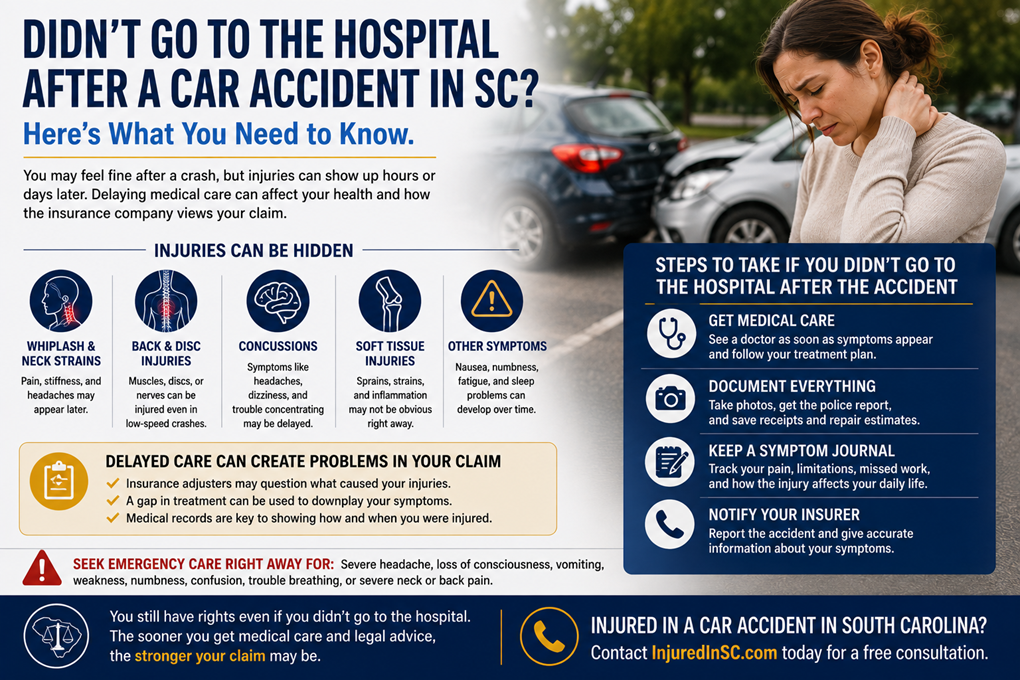
If you didn’t go to the hospital after a car accident in SC, you have not necessarily lost the ability to pursue an injury claim.
However, delaying medical treatment can create both health concerns and questions from an insurance company about when your injuries began and whether they were caused by the collision.
The important thing is what you do once symptoms appear.
Why Might You Feel Fine Immediately After a Crash?
Some accident-related symptoms are obvious right away. Others develop gradually.
After a collision, the stress of the event can make it difficult to recognize pain or other symptoms immediately.
Muscle stiffness, inflammation, headaches, dizziness, nerve symptoms, and concentration problems may become more noticeable later.
For example, someone may leave the accident scene believing they are merely sore, only to wake up the next morning with significant neck stiffness or back pain.
Potential delayed symptoms include:
- Neck or shoulder pain
- Lower-back pain
- Headaches
- Dizziness
- Nausea
- Muscle stiffness or spasms
- Numbness or tingling
- Weakness
- Trouble concentrating
- Unusual fatigue
- Sleep difficulties
You can learn more about why symptoms may develop later in the firm’s guide to delayed car accident symptoms in South Carolina.
Should You See a Doctor If You Did Not Go to the Hospital?
If symptoms develop after you leave the accident scene, consider obtaining an appropriate medical evaluation rather than waiting to see whether they disappear.
Going to a hospital emergency department is not the only possible form of medical care.
Depending on your symptoms, an urgent-care clinic, primary-care provider, or another appropriate healthcare provider may be able to evaluate you.
Certain symptoms require emergency attention. Call 911 or seek emergency care for warning signs such as:
- Loss of consciousness
- A worsening headache
- Repeated vomiting
- Seizures
- Increasing confusion
- Slurred speech
- Weakness or numbness
- Difficulty walking
- Severe neck or back pain
- Difficulty breathing
- Loss of bladder or bowel control
This comprehensive South Carolina Car Accident Injuries guide discusses common crash injuries, emergency warning signs, delayed symptoms, diagnosis, medical documentation, and insurance issues in greater detail.
Does Not Going to the Hospital Hurt Your Injury Claim?
It can create an issue, but it does not automatically prevent a claim.
An insurance company evaluating a personal injury claim may ask why you did not seek treatment immediately. The adjuster might argue that:
- You were not injured in the crash
- Your injuries were minor
- Your symptoms developed because of something that happened later
- A pre-existing condition caused the symptoms
- The treatment you later received was unrelated to the collision
The longer the unexplained gap between the crash and your first medical visit, the more opportunity an insurer may have to question causation.
That does not mean a delay has only one explanation. You may have believed the pain would resolve, lacked transportation, been unable to miss work, had difficulty getting an appointment, or simply did not initially realize that you had been injured.
When you do seek treatment, give your healthcare provider an accurate timeline. Explain when the crash occurred, when symptoms began, how they changed, and what activities they affect.
Medical Records Can Help Establish the Timeline
Medical documentation is especially important when you didn’t go to the hospital after a car accident in SC.
Your records may document:
- The date you first sought treatment
- When you say your symptoms began
- Which areas of your body hurt
- Your range of motion
- Numbness, weakness, or other neurological symptoms
- Examination findings
- Diagnostic testing
- Treatment recommendations
- Work or activity restrictions
- Changes in your condition over time
Do not exaggerate symptoms, but do not minimize them either. If your back pain begins traveling into your leg or a headache becomes associated with dizziness, tell the provider.
Consistent medical documentation can help show how your condition developed following the accident.
What Injuries May Not Be Obvious at the Scene?
Several common car accident injuries may not immediately produce dramatic symptoms.
Whiplash and other soft-tissue injuries can cause stiffness, tenderness, reduced range of motion, headaches, and muscle pain. Read more about whiplash after a South Carolina car accident.
Back injuries may involve strained muscles, ligaments, discs, joints, or nerves. Symptoms may include stiffness, spasms, radiating pain, numbness, or weakness.
Concussions can also be easy to overlook because a person does not necessarily have to lose consciousness or have a visible head injury.
Headaches, dizziness, memory difficulties, sensitivity to light or noise, and sleep changes may emerge later.
Even a collision involving limited vehicle damage can produce disputed injury claims. The also addresses whether a low-speed car accident can cause a serious injury.
What Should You Do If Several Days Have Already Passed?
Do not assume that it is too late to seek medical care or document what happened.
First, obtain an appropriate medical evaluation if you are experiencing symptoms. Be truthful about the date of the crash and when you first noticed each problem.
Next, preserve other evidence that may help establish what happened:
- Photographs of the vehicles
- Crash-scene photographs
- Witness names and contact information
- The collision report
- Repair estimates
- Insurance correspondence
- Receipts for accident-related expenses
- Records of missed work
You may also keep a factual symptom journal. Note when symptoms occur, what activities make them worse, whether they interfere with sleep, and what daily tasks you cannot perform normally.
The firm’s guide to what to do after a car accident in South Carolina provides additional information about medical care, evidence, police reports, and insurance issues.
What If You Told the Officer You Were “Fine”?
Statements made at the scene do not necessarily establish your medical condition for all time.
A person who says “I’m fine” may mean that they do not need an ambulance or that they do not believe they have a life-threatening injury. Symptoms can also change after the person leaves the scene.
If symptoms develop latr, describe that progression accurately to your healthcare providers and insurer. Do not try to rewrite what happened at the scene. Instead, explain what you felt then and what changed afterward.
Consistency and accuracy generally matter more than trying to present a perfect account.
Do Not Ignore Pre-Existing Conditions
An insurance company may also examine your earlier medical history, particularly if you previously experienced neck, back, shoulder, or joint problems.
A pre-existing condition does not automatically eliminate an injury claim. A collision may aggravate an earlier injury or cause a previously manageable condition to become symptomatic.
The firm’s article on how pre-existing conditions affect a South Carolina car accident claim explains how before-and-after medical evidence may help show what changed because of the wreck.
How Long Do You Have to Bring an Injury Claim?
South Carolina law generally provides three years for an action involving injury to a person. Section 15-3-535 generally requires an action under Section 15-3-530(5) to be commenced within three years after the person knew, or through reasonable diligence should have known, that a cause of action existed.
You can review the statutory language in the South Carolina Code of Laws on limitation of actions.
Different rules may apply in cases involving government entities, minors, or other special circumstances. The general three-year period also should not be treated as a reason to delay. Evidence can disappear and medical causation disputes may become harder to address over time.
You Still Have Options After Delayed Medical Care
If you didn’t go to the hospital after a car accident in SC, the absence of an immediate hospital visit does not automatically determine whether you were injured or whether you have a claim.
What matters is the complete evidence: when symptoms appeared, what medical providers found, how consistently you received treatment, what the collision involved, and how the injury affected your work and daily life.
If you developed pain or other symptoms after leaving the scene of a South Carolina crash, contact a personal injury lawyer in South Carolina to discuss what happened, your medical documentation, and the legal options that may apply.
This article provides general legal and medical information. It is not legal advice or medical advice, and no outcome is guaranteed. Seek emergency medical attention for serious or worsening symptoms.
Ready To Take Action?
It won’t cost you anything to speak with an attorney about your case.