
Can a Low-Speed Car Accident Cause a Serious Injury?
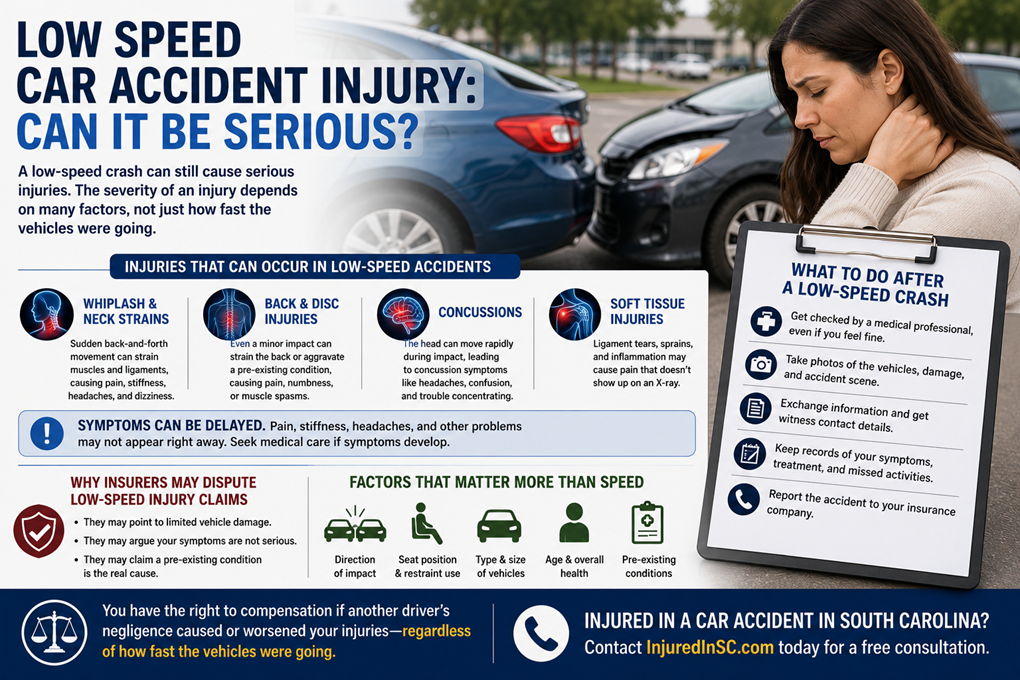
A crash does not have to happen at highway speed to cause an injury.
Even when the vehicles appear only lightly damaged, an occupant may experience neck pain, back pain, headaches, dizziness, numbness, or other symptoms after the collision.
A low-speed car accident injury can be difficult to understand because the condition of the vehicle and the condition of the person are two different questions.
Bumpers and other vehicle structures are designed to absorb or withstand certain forces, but an occupant’s body may still move suddenly during impact.
The seriousness of an injury depends on more than the speed shown on a dashboard.
The direction of the impact, the vehicles involved, the occupant’s position, seat-belt use, age, health history, and many other circumstances may affect the result.
The appearance of the vehicles does not provide a complete picture of an occupant’s health.
Learn more about injuries that may occur after a South Carolina car accident, including delayed symptoms and medical evaluation.
What Is Considered a Low-Speed Collision?
There is no single legal or medical definition that determines whether every crash is “low speed.” The phrase is commonly used for parking-lot crashes, slow rear-end impacts, and other collisions involving relatively limited vehicle speed or visible damage.
However, speed alone does not describe all the forces experienced by an occupant.
Researchers studying low-speed rear impacts have examined factors such as the vehicle’s change in velocity, acceleration, occupant movement, seat design, and head-restraint position.
The research does not support treating every minor-looking crash as medically harmless.
This does not mean that every low-speed collision causes a serious injury. It means the medical question should be evaluated based on the person’s symptoms and examination rather than an assumption drawn solely from vehicle damage.
What Injuries Can Follow a Low-Speed Accident?
A low-speed car accident injury may involve muscles, ligaments, discs, nerves, joints, or the brain.
Whiplash and Other Neck Injuries
During a rear-end impact, the head and neck may move rapidly in relation to the torso. This can strain muscles and ligaments in the neck.
Whiplash-associated symptoms may include neck pain, stiffness, headaches, shoulder or upper-back pain, arm symptoms, dizziness, visual complaints, and difficulty concentrating.
Diagnosis is often based on the history of the crash and a clinical examination because there is no single test that proves every whiplash injury.
The firm’s article about soft-tissue injuries after a South Carolina car wreck explains why strains and sprains can be challenging to document.
Back and Disc Injuries
A sudden impact may strain the lower back or aggravate an existing spinal condition. Some people develop muscle spasms, reduced mobility, radiating pain, tingling, or weakness.
Disc degeneration or an earlier back problem may complicate the medical analysis, but a pre-existing condition does not necessarily mean the crash caused no additional harm.
The relevant question may be whether the collision created new symptoms or made an existing condition worse.
Learn more about how pre-existing conditions affect a South Carolina car accident claim.
Concussions
A concussion does not always require a direct blow to the head.
The Centers for Disease Control and Prevention explains that a concussion can result from a hit to the body that causes the head and brain to move rapidly.
Motor vehicle crashes are one recognized cause of traumatic brain injury.
Possible symptoms include headaches, dizziness, nausea, sensitivity to light or noise, memory problems, difficulty concentrating, irritability, and changes in sleep. These symptoms may not all appear immediately.
Read more about concussion symptoms and claim evidence after a South Carolina car accident.
Why Can Symptoms Be Delayed?
Stress and adrenaline may make it difficult to notice discomfort at the accident scene. Muscle stiffness, inflammation, headaches, and nerve symptoms may become more noticeable later that day or during the following days.
Delayed symptoms do not automatically prove that a serious injury occurred. They also should not be dismissed simply because the person initially said they felt fine.
Seek medical care when new symptoms develop, particularly when they are persistent, worsening, or interfering with ordinary activities.
The guide to delayed car accident injury symptoms in South Carolina discusses this issue in greater detail.
When Should You Seek Emergency Care?
Call 911 or seek emergency evaluation for symptoms such as:
- Loss of consciousness
- Increasing confusion or unusual behavior
- Repeated vomiting
- A worsening headache
- Seizures
- Weakness, numbness, or poor coordination
- Slurred speech
- Difficulty waking
- Loss of bladder or bowel control
- Severe neck or back pain
- Trouble breathing
Concussion danger signs may indicate a more serious brain injury and require immediate attention.
Do not drive yourself when dizziness, confusion, severe pain, vision problems, or impaired coordination make driving unsafe.
Why Insurers May Dispute a Low-Speed Injury Claim
Insurance companies may point to limited repair costs, photographs showing little exterior damage, or a low estimated impact speed. They may argue that the collision could not have caused the reported symptoms.
Other common disputes include:
- The injured person delayed treatment
- Imaging showed no fracture
- The symptoms are subjective
- A prior condition caused the pain
- Treatment lasted longer than necessary
- The person’s activities are inconsistent with the claimed limitations
A claim should therefore focus on medical and factual evidence rather than labels such as “minor accident.” Research has found that collision severity and visible damage do not necessarily predict who will develop persistent neck symptoms.
What Evidence May Support the Claim?
Prompt medical documentation is important. Tell the healthcare provider how the crash occurred, when the symptoms began, and how they affect your movement, sleep, work, and daily activities.
Keep copies of:
- Emergency and follow-up medical records
- Diagnostic test results
- Bills and prescription receipts
- Work restrictions and wage records
- Photographs of the vehicles and scene
- Witness contact information
- Repair estimates
- Insurance correspondence
A short symptom journal may also help. Record specific limitations, such as difficulty turning your head while driving, waking because of back pain, missing work, or needing help with household tasks.
This article on what to do after a car accident in South Carolina includes additional steps for preserving evidence and obtaining medical attention.
Does Limited Vehicle Damage Reduce Compensation?
Vehicle damage may be relevant evidence, but it does not automatically determine whether an injury occurred or how much a claim is worth.
A settlement may depend on the diagnosis, duration of symptoms, medical expenses, lost income, daily limitations, evidence of fault, prior medical history, and available insurance coverage. There is no standard amount for every low-speed car accident injury.
Avoid settling before your condition is reasonably understood. Once a release is signed, you generally cannot reopen the claim because symptoms lasted longer than expected or additional treatment became necessary.
How Long Do You Have to File a Claim?
South Carolina Code Sections 15-3-530 and 15-3-535 generally require a personal injury action to be commenced within three years after the injured person knew, or through reasonable diligence should have known, that a cause of action existed.
Different deadlines or procedures may apply when a government vehicle, public employee, minor, or another unusual circumstance is involved. Insurance notice requirements and the need to preserve evidence can also make earlier action important.
Discuss Your Low-Speed Collision Injury
A low-speed crash should not be judged solely by the appearance of the vehicles. The meaningful questions are what happened to your body, what the medical records show, and how the symptoms have affected your life.
If you suffered a low-speed car accident injury in South Carolina, contact a personal injury lawyer in South Carolina to discuss the collision, your medical treatment, and the evidence that may support your claim.
This article provides general legal and medical information. It is not legal advice or medical advice, and no outcome is guaranteed. Seek prompt medical care for severe, worsening, or persistent symptoms.
Ready To Take Action?
It won’t cost you anything to speak with an attorney about your case.