
Concussion After a Car Accident in South Carolina: Symptoms and Claim Evidence
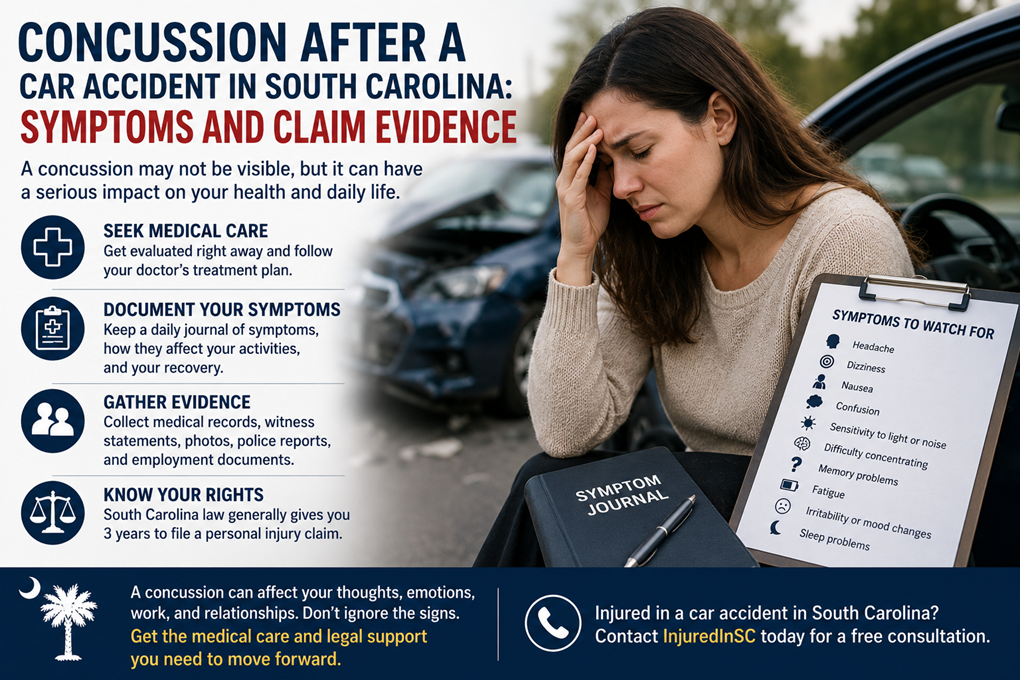
A concussion may not leave a visible injury, but it can affect how you think, feel, work, sleep, and complete everyday tasks.
Symptoms can begin at the accident scene or develop hours or days later, making the condition easy to overlook after a collision.
Anyone who suspects a concussion after a car accident in South Carolina should take the symptoms seriously.
Prompt medical attention is important for your health, while clear documentation can help establish what happened and how the injury has affected your life.
What Is a Concussion?
A concussion is a type of mild traumatic brain injury. It can happen when a blow or jolt causes the head and brain to move rapidly.
A person does not necessarily have to strike their head or lose consciousness.
The force created when the body suddenly stops, twists, or changes direction during a crash may be enough to cause an injury.
Although doctors may describe a concussion as “mild” based on the initial classification of the brain injury, its symptoms can still be disruptive or persistent.
The Centers for Disease Control and Prevention explains that concussion symptoms may affect thinking, learning, emotions, behavior, physical comfort, and sleep.
Common Concussion Symptoms After a Crash
Concussion symptoms vary from person to person. Some appear immediately, while others may not become noticeable until hours or days after the accident.
Physical symptoms may include:
- Headache or pressure in the head
- Dizziness or balance problems
- Nausea or vomiting
- Blurred or double vision
- Sensitivity to light or noise
- Fatigue or low energy
- Ringing in the ears
Cognitive and emotional symptoms may include:
- Confusion or feeling mentally “foggy”
- Difficulty concentrating
- Memory problems
- Slowed thinking or responses
- Irritability
- Anxiety or sadness
- Unusual emotional reactions
A concussion may also interfere with sleep. You may sleep more or less than usual, have trouble falling asleep, or wake frequently during the night.
People sometimes dismiss these problems as stress from the collision.
Stress may certainly contribute to how you feel, but new symptoms following a crash should be discussed with a healthcare provider.
Learn more about delayed car accident injury symptoms in South Carolina.
When Should You Seek Emergency Care?
Call 911 or go to an emergency department when a person shows concussion danger signs. According to the CDC, these may include:
- A headache that becomes worse and does not go away
- Repeated vomiting
- Seizures or convulsions
- Increasing confusion, restlessness, or agitation
- Slurred speech
- Weakness, numbness, or reduced coordination
- One pupil appearing larger than the other
- Loss of consciousness
- Extreme drowsiness or an inability to wake up
These symptoms may indicate a more serious brain injury that requires immediate evaluation.
Do not drive yourself if you are confused, dizzy, unusually tired, or having vision or coordination problems.
How Is a Concussion Diagnosed?
A healthcare provider may ask how the crash occurred, whether you lost consciousness, what symptoms you experienced, and whether you have a history of earlier concussions.
The examination may include tests of memory, concentration, balance, vision, coordination, reflexes, and strength.
A CT scan or MRI may be used to look for bleeding, fractures, or other structural injuries.
However, a normal imaging result does not necessarily rule out a concussion.
Diagnosis often depends on the patient’s reported symptoms and the provider’s clinical examination.
That makes it important to describe your symptoms accurately.
Tell the provider about headaches, nausea, memory lapses, sleep changes, light sensitivity, emotional changes, or problems completing ordinary tasks.
Do not exaggerate, but do not minimize what you are experiencing.
What Evidence Can Support a South Carolina Concussion Claim?
Because a concussion may not be visible on an imaging study, evidence beyond a single test result can be important.
A claim generally requires evidence connecting the injury to the crash and showing the resulting losses.
Medical Records
Emergency department records, examination notes, diagnostic testing, referrals, prescriptions, therapy records, and work restrictions may document your condition.
Consistent follow-up care can also show whether symptoms improved, continued, or changed over time.
Keep appointments and follow the treatment instructions you receive.
Unexplained gaps in care may give an insurance company an opportunity to argue that the injury resolved or was unrelated to the collision.
A Symptom Journal
Concussion symptoms can fluctuate. A simple daily journal may help you track headaches, dizziness, concentration problems, sleep disruption, medication use, and missed activities.
Record specific examples. Instead of writing only that you felt confused, note that you forgot an appointment, struggled to follow a conversation, or needed extra time to complete a familiar task.
A factual record may help your medical providers understand your recovery and may later support your description of the injury.
Statements From Other People
Family members, friends, and coworkers may notice changes that the injured person does not recognize.
They may observe unusual fatigue, irritability, forgetfulness, slowed speech, reduced productivity, or withdrawal from normal activities.
These observations do not replace medical evidence, but they may help explain how your behavior and abilities changed after the crash.
Crash Evidence
Photographs, vehicle damage, witness statements, police reports, traffic-camera recordings, and other evidence may help demonstrate the force of the collision and who caused it.
Preserve this information as early as possible because video may be erased and witnesses may become difficult to locate.
The firm’s guide on what to do after a South Carolina car accident explains additional steps for documenting the scene and protecting important information.
Employment and Financial Records
Save wage statements, attendance records, work restrictions, used leave, and communications with your employer.
These documents may help establish lost income or changes in your ability to perform your job.
Medical bills, prescription receipts, therapy expenses, and transportation costs should also be preserved.
The value of a claim depends on its individual evidence rather than a universal settlement figure.
Review the discussion of personal injury settlement factors in South Carolina for more information.
Be Careful With Insurance Statements and Social Media
An insurance adjuster may request a recorded statement soon after the accident.
At that point, you may not yet understand the full extent of your symptoms.
A casual statement that you are “fine” could later be used to question a concussion claim.
Be truthful, but avoid guessing about your diagnosis, recovery time, or future treatment.
You should also use caution on social media. Photographs and posts may be reviewed without context and used to argue that your symptoms are less serious than reported.
Do not settle a claim before you have a reasonable understanding of your condition.
Once you sign a release, you generally cannot seek additional compensation if symptoms continue or new treatment becomes necessary.
South Carolina’s Filing Deadline
Under South Carolina Code Sections 15-3-530 and 15-3-535, a personal injury action generally must be started within three years after the person knew, or through reasonable diligence should have known, that a cause of action existed.
Different requirements may apply in claims involving a government vehicle or public employee.
The general three-year period is not a reason to delay. Medical documentation, witness recollections, electronic data, and video evidence may become more difficult to obtain over time.
Remember, a concussion may occur along with neck pain, back injuries, soft-tissue damage, or other trauma.
Because accident symptoms can overlap or become noticeable at different times, it is important to consider the complete medical picture.
Visit our guide to South Carolina car accident injuries, symptoms, and treatment for a broader overview.
Discuss Your South Carolina Concussion Claim
A concussion can affect much more than your physical comfort. It may interfere with your memory, mood, relationships, employment, and ability to manage daily responsibilities.
If you suffered a concussion after a car accident in South Carolina, contact a personal injury attorney in South Carolina to discuss the crash, the available evidence, and the legal options that may apply.
This article provides general legal and medical information. It is not legal advice or medical advice, and no outcome is guaranteed. Seek emergency medical care for serious or worsening symptoms.
Ready To Take Action?
It won’t cost you anything to speak with an attorney about your case.