
Delayed Car Accident Injury Symptoms in South Carolina: How Long Can They Take to Appear?
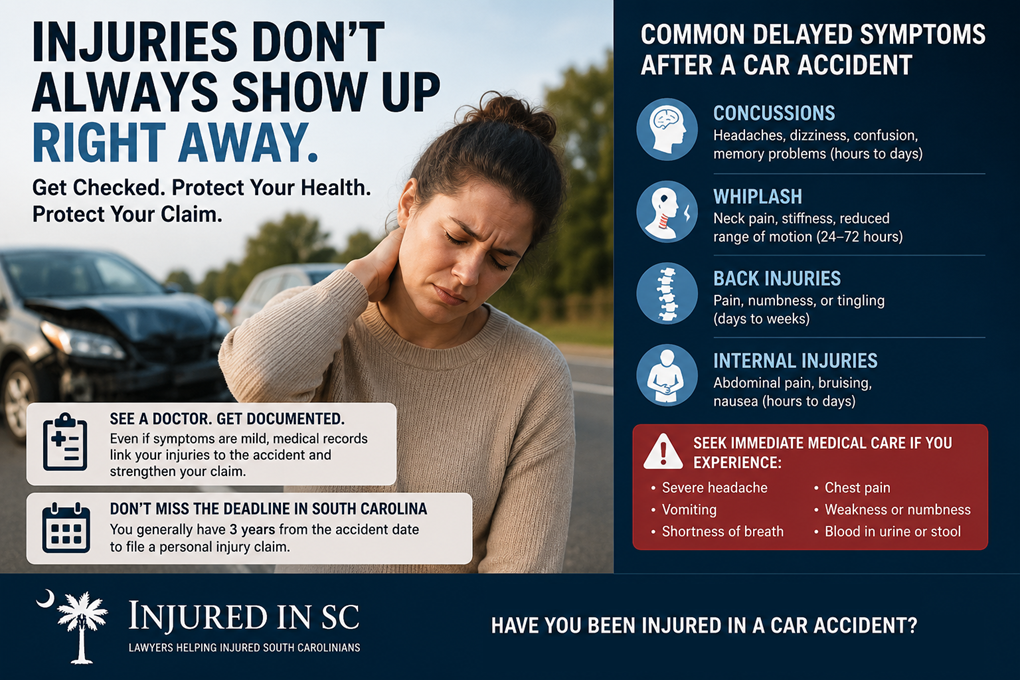
You may feel relieved when you walk away from a South Carolina car accident without obvious injuries.
However, the absence of immediate pain does not necessarily mean that you are not injured.
Some accident-related symptoms appear within minutes. Others develop gradually over several hours or days.
In some cases, an injured person does not recognize a problem until returning to work, driving, exercising, or completing other everyday activities.
Understanding delayed car accident symptoms South Carolina drivers may experience can help you recognize when to seek medical attention.
It can also help you preserve records that may become important if you later file an insurance claim or personal injury lawsuit.
Our South Carolina car accident injuries complete guide explains common injuries, emergency warning signs, diagnostic testing, treatment, and medical documentation.
How Long Can Car Accident Symptoms Be Delayed?
Delayed pain, headaches, dizziness, stiffness, numbness, and concentration problems can be associated with several different accident-related conditions
There is no single timeline for every collision-related injury.
The timing may depend on the type of injury, the severity and direction of the impact, the person’s age and health, and whether the person has previously experienced similar medical problems.
A general timeline may include:
- Within a few hours: Headaches, dizziness, nausea, stiffness, soreness, or fatigue may begin.
- Within one or two days: Neck pain, back pain, bruising, and reduced range of motion may become more noticeable.
- Within several days: Numbness, tingling, sleep disturbances, concentration problems, or worsening muscle pain may develop.
- After a week or two: Some people notice emotional changes, memory difficulties, or disrupted sleep as they resume their usual routines.
According to the Centers for Disease Control and Prevention’s guidance on mild traumatic brain injuries, concussion symptoms may appear immediately or may take hours or days to become noticeable.
The CDC also explains that some people notice emotional or sleep-related changes a week or two after an injury.
Symptoms that develop later should not automatically be blamed on the crash, but they should not automatically be dismissed either.
A healthcare provider can evaluate the symptoms, consider other possible causes, and recommend appropriate testing or treatment.
Common Delayed Car Accident Symptoms in South Carolina
Several types of injuries may produce delayed symptoms. The following are among the more common concerns after a crash.
Neck Pain and Whiplash
Whiplash happens when the neck moves rapidly backward and forward.
Although it is commonly associated with rear-end collisions, it can also occur in other types of crashes.
Possible symptoms include:
- Neck pain or stiffness
- Reduced range of motion
- Pain that becomes worse with movement
- Headaches near the base of the skull
- Shoulder, arm, or upper-back pain
- Dizziness or fatigue
- Tingling or numbness in an arm
The Mayo Clinic’s overview of whiplash states that symptoms most often begin within days of the injury.
It also recommends seeing a healthcare provider after an accident when neck pain or other possible whiplash symptoms occur.
Concussion Symptoms
A person does not have to lose consciousness to experience a concussion.
A concussion can result from a blow to the head or from an impact to the body that causes the head and brain to move rapidly.
Delayed concussion symptoms may include:
- Headaches
- Dizziness or balance problems
- Nausea
- Sensitivity to light or noise
- Blurred vision
- Fatigue
- Memory problems
- Difficulty concentrating
- Irritability or unusual emotional changes
- Changes in sleeping patterns
These symptoms may be easy to overlook because they can resemble stress, fatigue, or other health problems. Family members may sometimes notice changes before the injured person does.
The CDC’s concussion symptom guidance explains that symptoms can affect how a person feels, thinks, behaves, and sleeps.
Back Pain and Nerve Symptoms
Back pain may initially feel like ordinary soreness after a stressful event.
Over time, however, an injured person may develop sharp pain, muscle spasms, limited mobility, or pain that travels into an arm or leg.
A herniated spinal disk can irritate or press against a nearby nerve. Depending on the location of the injury, symptoms may include pain, numbness, tingling, or weakness in an arm or leg.
Some people with a herniated disk have no symptoms, which is one reason a medical evaluation may be necessary to determine the cause of new pain.
The Mayo Clinic’s herniated-disk information provides additional details about these symptoms.
Bruising and Possible Internal Bleeding
Bruises may become darker or more noticeable during the hours or days after a collision.
While ordinary bruising is not always an emergency, certain symptoms may indicate a more serious internal injury.
Warning signs may include increasing abdominal pain, abdominal swelling, chest pain, faintness, confusion, pale or clammy skin, shortness of breath, unusual weakness, or blood in vomit, urine, or stool.
Internal bleeding can quickly become life-threatening. MedlinePlus guidance on internal bleeding advises obtaining emergency help when internal bleeding or shock is suspected.
Which Symptoms Require Emergency Care?
Call 911 or go to an emergency department when an injured person experiences:
- A headache that becomes worse and does not go away
- Repeated vomiting
- Seizures or convulsions
- Slurred speech
- Increasing confusion or unusual behavior
- Weakness, numbness, or reduced coordination
- One pupil that is larger than the other
- Loss of consciousness
- Extreme drowsiness or difficulty waking
- Severe chest or abdominal pain
- Difficulty breathing
- Uncontrolled bleeding or signs of shock
The CDC identifies worsening headaches, repeated vomiting, seizures, neurological problems, unusual behavior, and difficulty waking as concussion danger signs requiring immediate medical care.
Do not delay emergency treatment while waiting to speak with an insurance company or a car accident attorney.
What Should You Do When Symptoms Appear Later?
When delayed car accident symptoms in South Carolina appear, consider arranging a medical evaluation as soon as reasonably possible.
Tell the healthcare provider when the collision occurred, how the impact happened, when each symptom began, and whether the symptoms are improving or becoming worse.
Follow the provider’s treatment recommendations and attend scheduled follow-up appointments. Keep copies of medical bills, test results, prescriptions, discharge instructions, work restrictions, and referrals.
You may also find it helpful to maintain a daily record of your symptoms.
Note changes in pain, mobility, sleep, concentration, and your ability to complete normal activities.
Be accurate and avoid exaggerating or guessing about your diagnosis.
Prompt medical documentation can help healthcare providers understand the progression of an injury.
It may also help address questions from an insurer about when the symptoms began and whether they are connected to the collision.
Can Delayed Symptoms Affect a South Carolina Injury Claim?
Delayed symptoms do not automatically prevent an injured person from pursuing compensation.
However, an insurance company may question whether symptoms that were reported later resulted from the crash or from another event.
Medical records, accident reports, photographs, witness statements, and consistent descriptions of the symptoms may all become relevant.
Because every case is different, no particular piece of evidence guarantees a specific outcome.
South Carolina also limits the time available to file a personal injury lawsuit.
Under South Carolina Code Sections 15-3-530 and 15-3-535, an action for injury to a person generally must be started within three years after the person knew, or through reasonable diligence should have known, that a cause of action existed.
Delayed symptoms do not necessarily extend this deadline.
Different rules may apply when a state agency, county, municipality, school district, or other governmental entity is involved.
Under the South Carolina Tort Claims Act’s statute of limitations, an action is generally subject to a two-year deadline.
The statute provides a three-year period in certain situations when the claimant first filed a qualifying claim under the Act.
Other deadlines or exceptions may apply depending on the facts and the parties involved.
Waiting until the filing deadline approaches can also make it more difficult to locate witnesses, obtain video footage, or preserve other evidence.
Discuss Your Delayed Symptoms and Legal Options
New pain or neurological symptoms after a collision deserve attention, even when you felt fine at the scene.
Seek emergency help for serious warning signs and talk with a healthcare provider about other new or worsening symptoms.
For questions about medical documentation, insurance communications, or filing deadlines involving delayed car accident symptoms South Carolina residents experience, contact a licensed South Carolina car accident lawyer to request a consultation.
A lawyer can review the specific facts and explain the options that may be available under South Carolina law.
This article provides general educational information and does not constitute medical or legal advice. Results depend on the facts and circumstances of each matter. Reading this article or contacting the firm does not, by itself, create an attorney-client relationship.
Ready To Take Action?
It won’t cost you anything to speak with an attorney about your case.