
Herniated Disc After a Car Accident: What South Carolina Victims Should Know
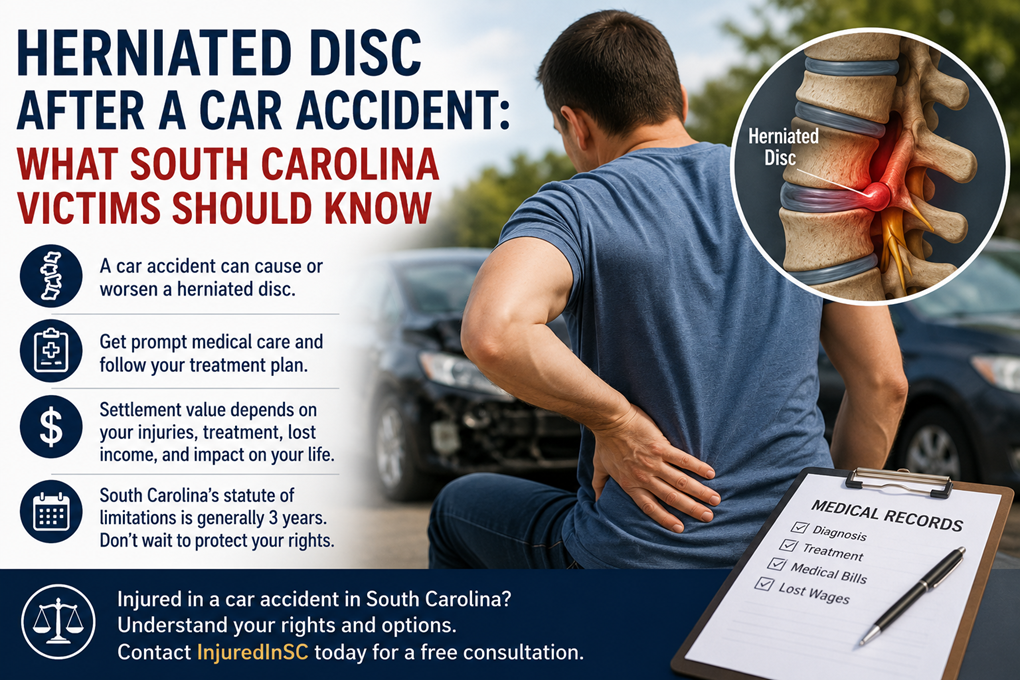
Herniated Disc After a Car Accident: What South Carolina Victims Should Know
A herniated disc can turn an ordinary day into a struggle with pain, numbness, weakness, and limited mobility.
When the injury follows a collision, you may also face medical bills, missed work, insurance calls, and uncertainty about your legal options.
People often search for information about a herniated disc car accident settlement in SC hoping to find a typical dollar amount.
In reality, there is no reliable average that applies to every claim.
The potential value depends on the medical evidence, the effect of the injury on your life, who caused the crash, available insurance coverage, and several other factors.
Understanding how these cases are evaluated can help you make informed decisions about your health and your claim.
A herniated disc can be one part of a larger pattern of accident-related injuries.
Some people also experience neck pain, headaches, numbness, weakness, joint injuries, or emotional symptoms following a crash.
Learn more about common injuries after a South Carolina car accident and how those injuries may be diagnosed and documented.
What Is a Herniated Disc?
The spine consists of bones called vertebrae, with flexible discs between them.
Each disc has a tough outer layer and a softer center.
A herniation occurs when material from the center pushes through a weakened or torn area of the outer layer.
A herniated disc does not always cause symptoms. When it presses on or irritates a nearby nerve, however, it may cause:
- Neck or lower-back pain
- Pain traveling into an arm, buttock, or leg
- Numbness or tingling
- Muscle weakness
- Reduced range of motion
- Pain that increases when coughing, sitting, bending, or lifting
The location of the symptoms often depends on whether the affected disc is in the cervical spine (neck) or the lumbar spine (lower back).
The American Academy of Orthopedic Surgeons’ herniated-disc guide provides additional information about symptoms and treatment.
Can a Car Accident Cause a Herniated Disc?
A collision can place sudden pressure on the spine.
The body may twist, bend, or move rapidly against a seat belt while the vehicle changes direction.
This force may damage a disc or aggravate a disc that had already begun to deteriorate.
Symptoms may appear immediately, but they can also become noticeable hours or days later.
Stress and adrenaline may initially distract you from pain, while swelling and nerve irritation can develop gradually.
Delayed symptoms do not prove that the crash caused the condition, but they also do not mean the injury is unrelated.
A medical provider must consider your symptoms, examination findings, health history, and diagnostic testing.
For more information about symptoms that may not appear at the scene, read about delayed car accident injuries in South Carolina.
How Is a Herniated Disc Diagnosed?
A healthcare provider may test your strength, reflexes, sensation, mobility, and areas of tenderness. Imaging may also be recommended.
An X-ray can help identify fractures and alignment problems, but it does not clearly show the soft tissue of a spinal disc.
An MRI can display discs, nerves, and other soft tissues and may show whether a herniated disc is compressing a nerve or the spinal cord.
Treatment varies according to the location and severity of the condition.
It may include activity changes, medication, physical therapy, injections, or, in some cases, surgery.
Initial treatment is frequently nonsurgical, although a physician may discuss surgery when symptoms continue despite conservative treatment or when significant neurological problems are present.
Seek immediate medical attention if you experience loss of bladder or bowel control, numbness around the groin, rapidly worsening weakness, difficulty walking, or other severe neurological symptoms.
What Affects a Herniated Disc Car Accident Settlement in SC?
No formula can determine the value of a claim from the diagnosis alone.
Two people with similar MRI results may have very different symptoms, treatment needs, occupations, and recoveries.
Important considerations may include:
The Connection Between the Crash and the Injury
The available evidence must support that the collision caused or aggravated the herniated disc.
Relevant evidence may include emergency-room records, physician notes, imaging, prior medical records, and testimony about when symptoms began.
A lengthy unexplained delay in seeking care can lead an insurer to question whether the injury resulted from the wreck.
Prompt treatment creates a clearer record and, more importantly, gives you an opportunity to receive appropriate medical guidance.
The Severity and Duration of Your Symptoms
A claim involving temporary discomfort and limited treatment will generally be evaluated differently from one involving persistent nerve pain, weakness, injections, surgery, or permanent limitations.
Medical providers’ opinions about your prognosis and anticipated future care may be especially important.
Insurers may also examine whether you followed treatment recommendations and attended appointments.
Medical Expenses and Lost Income
Past medical bills may be part of a claim, along with reasonably supported future treatment costs.
Lost wages, reduced hours, used leave, and diminished earning capacity may also be relevant when the injury affects employment.
Keep copies of bills, receipts, wage records, work restrictions, and communications with your employer.
The site’s overview of personal injury settlement considerations in South Carolina discusses how the nature of an injury and its effect on everyday life may influence a claim.
Pain and Changes to Daily Life
A herniated disc may interfere with sleeping, driving, household chores, exercise, childcare, and recreational activities.
These effects are sometimes called noneconomic losses because they do not come with a specific invoice.
A daily journal can help document changes in pain, mobility, sleep, and activity. Keep entries factual and avoid exaggeration.
Fault and Insurance Coverage
A settlement also depends on whether another driver was legally responsible and whether the evidence supports that conclusion.
Photographs, witness information, vehicle damage, police reports, and available video may help clarify how the crash occurred.
Insurance policy limits can affect the amount realistically available.
Additional coverage, such as underinsured motorist coverage, may become important when the at-fault driver’s liability coverage is insufficient.
Review what to do after a South Carolina car accident for practical guidance about medical care, photographs, witnesses, and insurance communications.
What If You Had a Preexisting Disc Condition?
Disc degeneration becomes more common with age, and an MRI may reveal changes that existed before the accident.
An insurer may use those findings to argue that the crash did not cause your symptoms.
A preexisting condition does not automatically eliminate a claim. A collision can aggravate an earlier condition or turn a previously asymptomatic condition into a painful one.
Prior medical records, testimony about your abilities before the wreck, and your treatment history after it may help distinguish an old condition from a new aggravation.
The central issue is often not whether your spine was perfect before the crash, but whether the collision caused a measurable change in your symptoms, treatment needs, or ability to function.
Avoid Settling Before Your Condition Is Understood
An early offer may arrive before you know whether therapy will work, whether injections will be recommended, or whether surgery might become necessary.
Once you sign a release, you generally cannot reopen the claim simply because your condition later worsens.
Before resolving a claim, consider whether your diagnosis, prognosis, work restrictions, and future treatment needs are reasonably clear. Avoid relying on online settlement calculators or isolated verdict reports.
They cannot account for the specific medical, factual, and insurance issues in your case.
How Long Do You Have to File a Claim?
South Carolina law generally requires an action for personal injury to be commenced within three years after the injured person knew, or through reasonable diligence should have known, that a cause of action existed. The applicable language appears in South Carolina Code Sections 15-3-530 and 15-3-535.
Different rules may apply when a government vehicle, public employee, minor, fatality, or another unusual circumstance is involved.
Waiting can also result in lost video, unavailable witnesses, and incomplete records, even when the general filing deadline has not expired.
Discuss Your South Carolina Herniated Disc Claim
A herniated disc claim requires more than an MRI result. The complete picture includes how the collision happened, what your doctors found, the treatment you need, and how the injury has affected your work and daily life.
If you are evaluating a possible herniated disc car accident settlement in SC, contact a car accident lawyer in South Carolina to discuss the circumstances of the crash and the legal options that may apply.
This article provides general legal and medical information. It is not legal advice or medical advice, and no result is guaranteed. Seek prompt medical care for symptoms following a collision.
Ready To Take Action?
It won’t cost you anything to speak with an attorney about your case.